Saturday, December 18, 2010

Ron Fletcher Towel Work

The type of Pilates I teach emanates from the work of Pilates Elder Ron Fletcher. Being a Pilates Elder means that he was one of Joseph Pilates' original students. All of my teachers have worked directly with Mr. Fletcher. I am honored to have received personal instruction from him as well.

Presentations and courses that I conduct as Pilates For Stylists incorporate elements of exercises I learned as Fletcher Pilates TowelWork.
I know from personal experience the value adding this type of exercise and conditioning for the hairdresser. This type of towel work will increase the hairdresser's flexibility and balance left to right.

To execute this at the salon or home, take a long towel and fold in half twice long ways and roll into a rope like manner.
To order the braided towel seen here, see the bottom of this post. This workout was published in Pilates Style magazine. To view the article in its entirety, go here.

The Ron Fletcher Towel Workout

Use a simple braided towel for this dynamic set of movements

by John White

Towel work is indispensable in teaching shoulder girdle stabilization and correct movement of the arms. You will immediately appreciate the effectiveness of this work and the fact that you can practice it at home with an everyday piece of "equipment." Athletes and dancers love ... giving them an intense stretch and workout.

Here are two movements to get you started. The first introduces a basic action and the next elaborates it into a phrase of movement.

Simple Side Bend

Use this exercise to strengthen and stretch the muscles of the waist.

Step 1

1
Begin standing in a wide turned-out position with the taut towel directly overhead.

Step 2

8
Take four full breaths while slowly bending the body to the side: Divide the space between where you start (upright) and where you'll end up (side bend) into four equal segments, one breath for each. Each inhale lengthens the waist and each exhale bends the body more to the side. Maintain proper alignment! Keep the shoulders anchored down, the abdominals pulled in tight and the hips centered over the legs.

Step 3

2
Inhale as you briskly bring the body back upright. Exhale in place, deepening the connection to your core muscles.

Perform this movement twice on each side, alternating sides as you go. Then do it twice more, dividing the side bend into just 2 equal movements; finally, perform the side bend in one single motion, 4 times, side to side.

Shoulder Stretch with Contraction

This movement includes articulation of the entire spine and a large range of motion for the shoulders. Only perform this if your shoulders and chest are flexible enough. If you aren't sure, ask an instructor to determine your flexibility.

Step 1

3
Begin standing with legs and feet together, with the towel taut against the hips.

Step 2

4
As you inhale, circle the arms up and over the head in one continuous motion.

(Next Step)

6
When the towel touches the back of your body, exhale as the low belly contracts and the knees bend.

(Next Step)

7
Continue into a deep contraction, pulling the arms into the body, bowing the head and rounding the back.

To finish the movement, reverse the sequence. Perform 8 times. Give the long circle of the towel a flowing feel, with a moment of suspension at the top of the movement.


To purchase a the Ron Fletcher towel and the braided towel, go here. To find a Fletcher Pilates studio or teacher in your area, go here.


Mr. Ron Fletcher with my Pilates student, Helen Rodriguez, San Antonio Texas.

Saturday, October 9, 2010

Pilates For Stylists: Shoulders

"Risk factors." "Contribution to injury." "Control measures." "Hazards." These phrases comprise a typical occupational health and safety presentation.


Pilates For Stylists: Shoulders is NOT your typical workplace safety course! Created for stylists by a stylist, this course promises to be informative, interactive and fun.


"Actions of the shoulder." "Balance." "Shoulder Shrugs." "Core." These are the phrases stylists will hear. Stylists will perform an exercise series developed to enhance their occupational performance. Stylists will leave feeling better. Best of all, stylists are better equipped to reduce and prevent injuries and disabilities associated with their work in salons.

FL DBPR Provider # 0005136
Course # 0500059
Occupational Safety Health Administration - 1 hour
Course Instructor: Carolyn Bell
210.280.6900
pilatesforstylists@gmail.com


The Pilates plank and side plank are movements that can help the stylist build core strength and shoulder endurance. Modifications of the hand position and body elevation can be made for stylists suffering from Carpal Tunnel Syndrome, tendonitis and other disorders.

Friday, March 26, 2010

Lower Body Workout

Sculpt the butt. Lose fat in the hips and thighs. Strengthen quads to reduce risk of injury and pain in the knees. Healthier hips and shapelier legs are the benefits of this workout.

Visit my site, Carolyn Bell Pilates/Lower Body Workout for this free tutorial. Consult your physician to determine if you are healthy enough to do this workout.

Sunday, June 28, 2009

Bridge To A Better Back

Low back pain is a common complaint of stylists. Causes for this are many. A Pilates assessment would likely discern fatigue in the back extensors, often accompanied by core weakness.

The Shoulder Bridge exercise can bring the Stylist practicing Pilates multiple benefits. Pelvic curls help stretch the back extensors, relieving tension. Spinal articulation maintains or increases mobility, resulting in functional movement. The abdominals are the main muscle focus in the exercise, which develops the core and supports the back. The hamstrings and glutes also benefit from engagement.

SHOULDER BRIDGE Prep


Directions:

1. Lie on your back with your feet hip distance apart , heels directly under your bent knees. Press arms to the floor alongside the body.
2. Tilt the pubic bone towards the chest, contracting the abdominals. Use an inhale to initiate the movement and an exhale to complete the movement, pulling the abs towards the low back as it flattens to the floor. The buttocks will lift from the floor and the low back to the shoulders will press closer to the floor.
3. Taking a second breath, lift your vertebrae one at a time off your mat/floor. The pubic bone should continue to tilt towards the chest to avoid anteriorly tilting the pelvis. Keep the weight of the body balanced between the upper body and feet, arms pressed into the floor. Do not allow the ribs to lift out of alignment with the hip bones, which will thrust the thoracic spine forward. In Fletcher Pilates, the back resembles a plank from the knees to shoulders rather than an arch between the shoulders and hips.
4. Slowly roll your spine back down, allowing each vertebra to fall back onto the mat one by one to the hip bones during your first breath. On your second bread, roll the pubic bone away from the chest until the hip bones and pubic bone are level, making a triangle.
Toned and strong core. Healthy back. Check.

Tuesday, May 12, 2009

It's All In The Wrist

One of the muscuoskeletal issues I personally deal with as a result of my 20+ years in the hair biz is loose ligaments in my wrist. While not painful, this has led to hypermobility and laxity of the wrist joint, instability in the carpal tunnel of my cutting hand. I find it challenging to build strength now along the whole chain; the hand, arm and shoulder on my right side.
In my career, I took for granted that my hand performed as I needed it to. I never realized the complications that would come later. I wished I had learned about creating more strength and flexibility.

Here are some exercises for the wrist you may find helpful. As with any exercise, avoid if you are experiencing pain and consult with your doctor if you are currently symptomatic and under the care of a doctor.

I like to preform these exercises in the quadraped, or all fours, position on a mat. I do both hands at the same time.

WRIST EXTENTION


"Hold your arm vertically, then press your hand with the palm facing up onto a firm surface. Apply moderate pressure." - CarpalTunnelExercises.com


WRIST FLEXION


"Hold your arm vertically, then press your hand with the palm down onto a firm surface. Apply moderate pressure" - CarpalTunnelExercises.com

Sunday, April 12, 2009

Twist Like a Barber Shop Pole

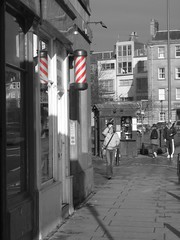
Spine Twist, the Pilates exercise for rotation, reminds me of barber shop poles. As we know, the poles have a red line that twists perpetually upward, catching the eye of prospective customers. When I practice Spine Twist, I envision my spine twisting upward like a barber pole.

We would all benefit from a perpetual lift as we rotate side to side. Twisting works the obliques and the back extensors, the muscles along the spine to help keep us erect or to extend. This type of exercise is beneficial for stylists because it helps balance rotation from side to side. As stylists, we typically twist from our dominant side to our recessive side all day.

Please see links for full instructions to properly perform the Spine Twist.

As a guide...

  • Sit in a L shape design with arms extended to sides from shoulder.
  • Turn upper body to one side as you prohibit movement in shoulder and pelvic girdles.
  • Return to center. Repeat to other side.
  • Rotation may also be done seated in a chair, while in the break room for example.
Spine Twist video here.
Photos here.

I got a note from Marguerite Ogle, About.com Guide To Pilates author, requesting I remove the photos from this site. Please see the link above to the post that contains the pictures.

Tuesday, March 24, 2009

Pilates For Feet by M. Black

I am not the only Pilates teacher thinking about feet lately. Madeline Black just wrote an article for Pilates-Pro.com...

"The feet are very important to the way we engage the body, and they deserve more attention. Feet bring to mind metaphors for moving us forward in life and finding our sense of place and existence in the world."

"Our feet are not only our sensory input telling us where and how to step, but also they set up the balance of our pelvis and translate through the spine. How you use your feet has a direct influence on your core. The way we stand on our feet, or how we move the feet, recruits different muscle lines up the leg into the pelvis. Body weight from our spine and pelvis is placed on the legs through the femur into the tibia. At the end of the tibia sits the talus. "


She includes feet exercises that would helpful to anyone but stylists in particular:
Arches In, Arches Out, Doming the Foot, Inch Worm and Toe Extensor and Flexor Exercises.

For the entire article, visit Pilates For Feet.